

Do you believe beige and other neutral tones are more refined than bright colours? Do you see patterned outfits as “too much”? Does visible cleavage signal moral descent to you? You just might be contributing to something more dangerous than you think.
Fascism, extreme nationalism that demands supremacy of the nation over the individual, requires mass participation. Unlike other authoritarian systems, it doesn’t need its citizens to be docile recipients of subjugation, but rather active participants and believers in their racial, ethnic, or religious superiority.
Due to fascism’s insidious nature, one might be oblivious to its creeping totalitarian control. After all, it sells a seductive myth, capitalising on present pain like economic instability to make people wistful for a time that never existed—a time that was safe, prosperous, and simple for the everyday man.
For fascism to take its people back to this mythic past, it needs to parrot traditionalism, nationalism, and a rejection of modernity. In Nazi Germany—a popular fascist state—when a ministry was created to control all aspects of culture and arts, it chose to popularise traditional “German” and “Nordic” values, framing foreign art and style as degenerate and corrupting.
Fascism also needs its subjects to be devoid of personality. If people think of themselves as autonomous individuals, they can’t be turned into enforcers of conformity. This is a crucial weapon for creating and protecting a homogenous state.
Fashion becomes a way to achieve this. It creates a strong visual code for those deemed respectable participants of society. By getting everyone to look the part, fascist regimes can enforce conformity. This works because clothing is inherently political. It’s publicly visible and constantly interpreted, making it an easily legible way to understand a person’s politics or cultural affiliations. Human behaviour researcher Desmond Morris explains this phenomenon in his book Manwatching, with a line reading, “It is impossible to wear clothes without transmitting social signals. Every costume tells a story, often a very subtle one, about its wearer.” In democracies, fashion expresses individuality and belonging. In fascist and fascist-adjacent systems, it becomes a compulsory performance of allegiance.
Minimalism and modesty become the aesthetics deployed to enforce this allegiance. They evoke simplicity, “purity”, tradition, and discipline.
Read also about the stylist behind Tems’ Raindance music video
Fascist Minimalism
Minimalism is not inherently harmful; not everyone is a fashion radical, nor should they be expected to be. Nevertheless, minimalism has been weaponised by oppressive systems to appear benign, even virtuous.
The psychological trick is elegant: by stripping away excess, minimalism brands itself as disciplined, humble, and accessible. It positions itself as the antithesis of vanity and elitism. This is what makes it so effective as a tool of control.
Adolf Hitler understood this perfectly. Author Jane Thynne wrote in her historical novel “Black Roses”, “Hitler saw fashion both as an ideological instrument, and as a way to control German women”
His personal aesthetic was a quasi-deceptive minimalism. During the Second World War, when he needed to build morale among German soldiers, he ditched his brown suit for the field-grey military tunic, deliberately mirroring the uniform of the average Wehrmacht soldier. This separated him from his generals, who adorned themselves with braided shoulder boards, collar-rank insignias, and medals. Hitler’s double-breasted tunic displayed only three items: a golden Nazi Party eagle, an Iron Cross, and a Wound Badge from the First World War. The message was direct: he was a modest, simple man, too focused on duty to care for personal adornment.
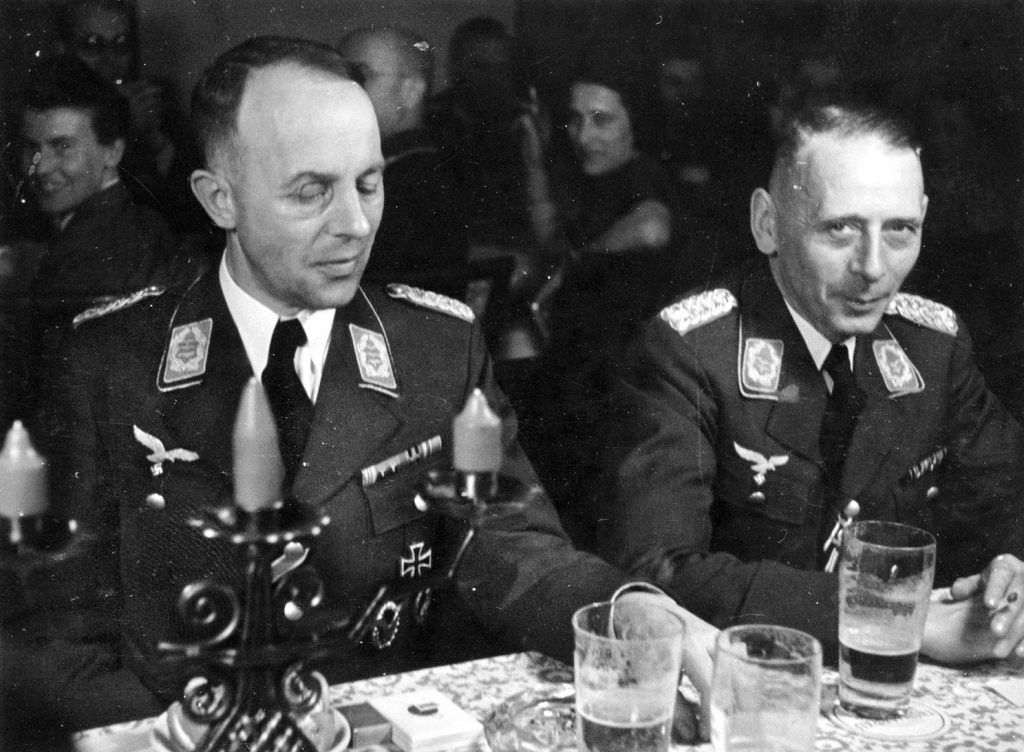
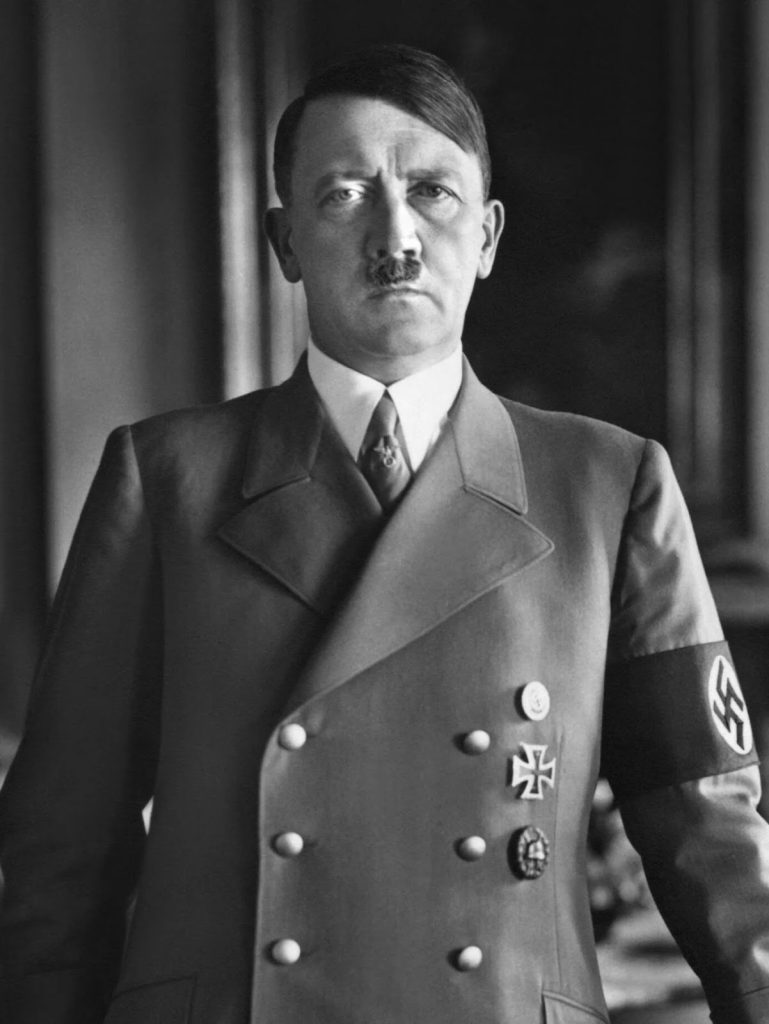
Credits: Warfare History Network.; German Federal Archives
Hitler’s investment in minimalist aesthetics went far beyond his own wardrobe. Through the Deutsches Modeamt (German Fashion Bureau), established on June 7th, 1933, he institutionalised aesthetic control over the entire German population. The regime distributed style guides dictating acceptable dress, particularly for women. Makeup was forbidden, as Hitler claimed women needed to glow from “health and love of country”. Hair dye and nail polish were condemned alongside cosmetics as “immoral, whorish fashions.” Women were instructed to dress in traditional folk costumes like the dirndl or tracht. These were dresses with fitted bodices, full skirts, and aprons that projected modesty and rural simplicity. This promoted his vision of the traditional Aryan woman: a modest, rural, and unthreatening woman.
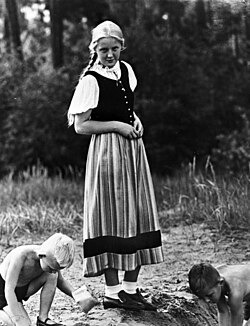
Image courtesy of German Federal Archives, licensed under CC BY-SA 3.0
Read also how 14th-century prostitutes influence today’s fashion
Minimalism as Class Control
Contemporary consumer culture has adopted this playbook, though the enforcement mechanism has shifted from state mandate — with law and violence — to market pressure — with aspirational capitalism and social exclusion. The result is different in degree but disturbingly similar in psychological function: make aesthetic restraint the norm, and punish the other.
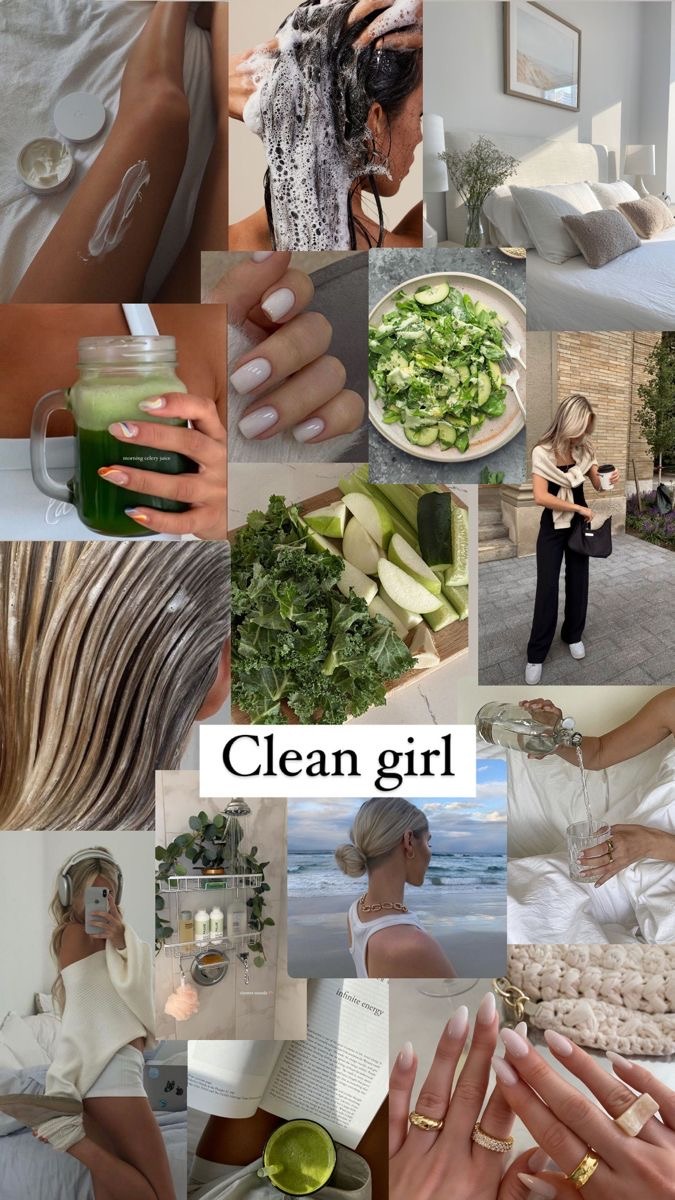
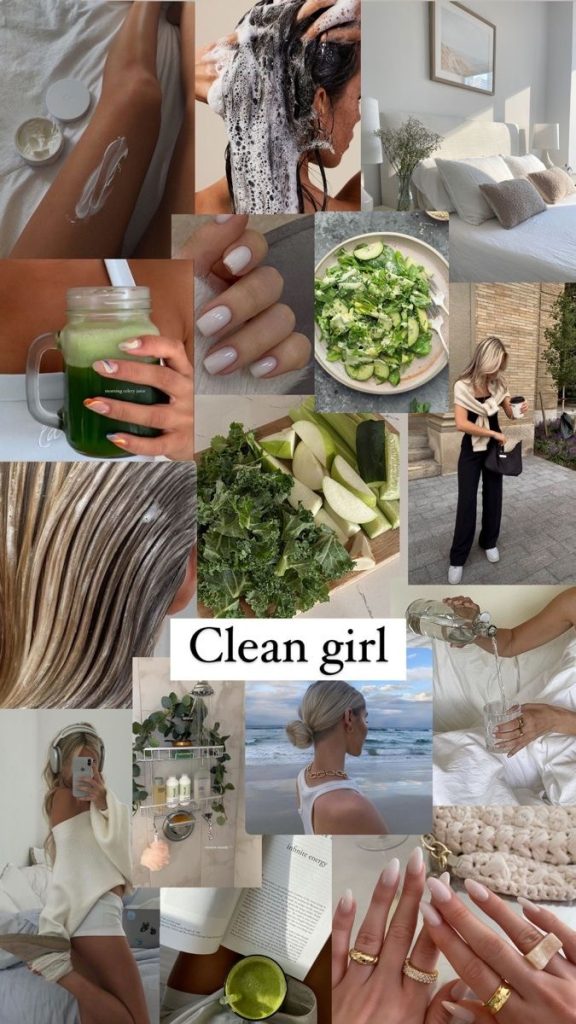
The “clean girl” aesthetic exemplifies this. What began as a reaction to maximalism and overconsumption, and marketed as effortless elegance, has evolved into a rigid template of respectability. The aesthetic demands hair tied in a bun or worn in a “tame manner”, dewy skin that’s meant to appear effortless despite the rigorous skincare routine needed to achieve it. It requires well-tailored clothes made from quality fabric designed to be simple and neutral-toned; colours that can’t stand the test of rigorous daily life.
Similar to Hitler’s uniform, the “clean girl” aesthetic performs humility while requiring significant resources. It creates a uniform for what acceptable femininity is, albeit one unachievable by most.
The word “clean” tells you everything. It essentially brands the “other” as dirty. Major fashion publication i-D Magazine confirms this exclusionary function, “Through its TikTok virality, images of how to behave, look and even eat like a clean girl have revealed society’s innate ability to reinforce exclusionary Euro-centric beauty standards.”
Deviation is met with condescension: bright colours, bold prints, patterns and visible makeup are all dismissed as tacky or try-hard.
Enforced Fashion Rules under Fascism
Conservatism doesn’t equal fascism, but fascist regimes have consistently weaponised conservative dress codes to control women’s bodies, the demographic most vulnerable to dress politics. La Nuova Italiana (The New Italian Woman) is an excellent example of this trajectory. It was a publishing body created under Mussolini to impose hyperfeminine dress codes on women. Through magazine editorials, runway shows, and billboards, the image of Mussolini’s ideal woman was aggressively circulated.
After the First World War, women had begun gaining freedoms: bobbed hair, makeup, shorter hemlines, and trousers. This threatened Mussolini, who understood that women, the procreating sex, wielded significant power in the continuation of his fascist state. To control them, he needed a tool that was controllable at every level: production (textiles and manufacturing), distribution, and advertising (magazine covers, billboards, cinema).
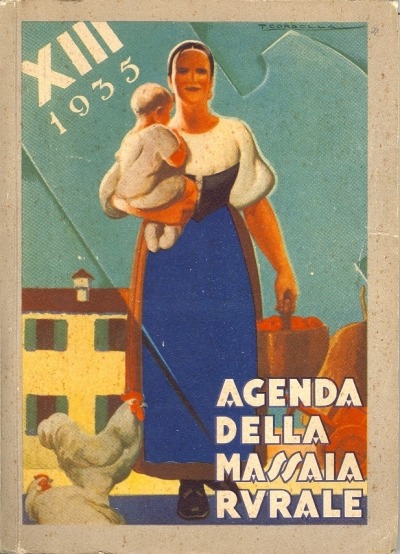
Fashion fit perfectly, and the ideal woman was manufactured. She never wore dresses above the knee; she favoured sophisticated and hyperfeminine silhouettes designed to emphasise traditional womanhood. But this sophistication was reserved for the runways and exclusive fashion shows meant to project Italian design prowess to the world. On the magazine covers and posters — the media more easily disseminated to everyday women — a different aesthetic was pushed: peasant fashion.
This was the image circulated en masse: flowing ankle-length skirts, long billowing sleeves, round high necklines, hair braided into plaits or twisted into modest buns, and a colour palette meant to signal countryside femininity. It projected brilliant white, soft pastels, and pretty floral prints.
She dared not wear the black shirt uniform worn by male fascists unless she was ‘chosen by the secretariat after seeking the opinion of the local men’s Fascio’. Every element was a visual reminder that women belonged in the fields and not in the city, getting drunk at a jazz club or taking up space in the workforce alongside men. She was meant to be the epitome of rural innocence: simple, modest, hardworking, with a tinge of childlike delicateness that rendered her unthreatening and perpetually in need of male protection.
The Return of Enforced Femininity in Fashion
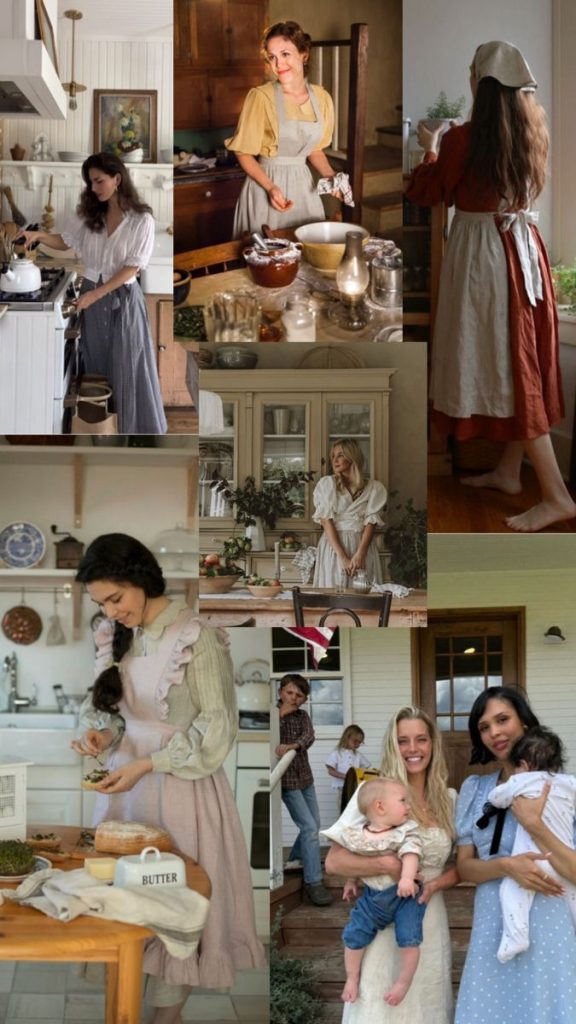
This visual language has been repackaged. The “tradwife aesthetic” takes this further, explicitly romanticising domestic subordination. As the Brown Political Review observes, “By selling conservatism as an aesthetic rather than an ideology, the tradwife movement makes regressive gender politics feel personal, beautiful, and aspirational.”
The tradwife women appear in modest floral dresses with full skirts, fitted bodices, hair long and styled in vintage waves, always photographed in the kitchen wearing a vintage-inspired apron, baking sourdough for social media.
She’s performing pre-feminist gender roles as lifestyle content, wrapping the visual codes of femininity in personal choice and aesthetic preference. The ankle-length skirts, the modest necklines, the emphasis on domestic labour disguised as softness and innocence— it’s La Nuova Italiana translated for TikTok.
Nigeria’s Enforced Modesty
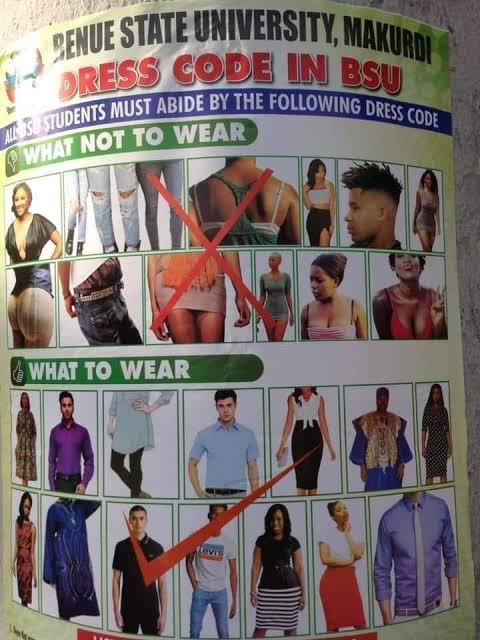
Enforced modesty is something we Nigerians can relate to; for us, it goes beyond social media. Although not a fascist state, Nigeria operates under moral authoritarianism, where social order is imposed by controlling public self-expression.
This is starkly visible in University campus dress codes: no baggy or ripped jeans, no sleeveless tops, no short skirts, no cropped tops or backless clothes. Outfits are common among Nigerian youths navigating their identities. As a country deeply entrenched in religion, it’s easy to ascribe a holy mantle to these restrictions, but it’s a very dangerous precedent to set, that a young woman’s education can be disrupted if her shirt doesn’t meet an administrator’s arbitrary standard of modesty.
We live in a world descending into authoritarian rule, so choosing how we present ourselves is a reminder of our agency. Mussolini himself recognised it: “If fashion says skirts are short, you won’t succeed in lengthening them, even with a guillotine.” If a powerful 30s dictator could attest to the power of fashion, shouldn’t we take it seriously?
George Ukanwoke is a designer and fashion researcher examining the intersection of fashion, politics, and culture.