


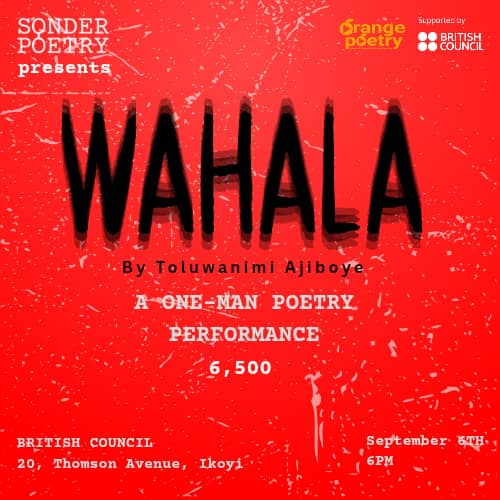
“I don’t delete ideas, I just store them,” The 26-year-old Toluwanimi Ajiboye says across the phone. It is a Monday afternoon, and yes, he is at work. His day job is in customer service, but his weekend job varies—sometimes it’s in poetry, and other times, it’s comedy. But if that confuses you, all you need to remember is that he is hosting Wahala, a poetry show, this Saturday at the British Council (20 Thompson Avenue, Ikoyi).
MEET TOLUWANIMI AJIBOYE:

“Recently, someone told me that they can not take me seriously because of my work with Improv Circle. It is amusing how to some people, I am the sad guy, and to others, I am the class clown. I am still navigating both, but I find it hilarious,” Ajiboye says in between work hours. The 5’9 Lagosian has spent most of his day tallying customers’ complaints, and he will spend the rest of the day doing so. Our phone call disrupts his routine, and for him, that’s the exciting part of everything… the disruptions.
He owes disruption a great deal, as he knows that if he had never embraced it, he would have been in a court trying to convince a judge that his guilty client is not so guilty. That’s not a bad life, but it is not a fulfilling one, especially for someone who has been putting his art out since he was a kid. “My relationship with poetry is familiar, and I can not explain, but it feels like home. My first few poems were by a Christian group called P4CM (Passion 4 Christ Movement). I might not have been the biggest believer, but a well-written poem is a well-written poem!”
He admits that in the current political climate, admitting to loving poetry as a kid raises all nepo baby alarms. But he expresses that there are more complexities to that discussion, and if he had to choose, he’d self-describe as having a middle-income upbringing. He shrugs to acknowledge if it is the upper or lower part of the middle socioeconomic hierarchy.
Instead, he jokes that we have forgotten what the middle class of Nigeria is. It is not a nepo baby with access and connections, but it’s not a child dependent on Lapo Microfinance Bank for survival, colloquially referred to as a Lapo baby. It is often a lot of communities and religious institutions, and his was church, Facebook, and school.
“My first poetry reading was in church. It was in 2015, and I was heavily influenced by rap at the time. To be precise, Kendrick Lamar was my gateway drug, and I loved his rhyme schemes. The poem was entirely rhymed and quite long. I had shared it with a poet I admired on Facebook, and he made some improvements. Unfortunately, my teacher in church shut it down… it was about God. Then I joined poetry slam groups.”
His next gigs, and first paid one, would be at his alma mater, the University of Lagos (Unilag). “I had a short pitch, give me 5,000 naira, and I will blow your mind. It worked. Then I did it again and again, slowly increasing the cost. Then, at the height of my Poetry in Unilag, COVID happened, and it set me back two years.”
However, Ajiboye has since found his way back to poetry. As a member of the poetry community, Sonder Poetry, he is involved with monthly events. “Our poetry events are interactive; it’s called Sonder Together. There’s the idea that poems start conversations, but rarely do they actually do. Most people listen to poems and go about their day… at Sonder Together, we invoke these conversations.”
He also had a poetry show at the Alliance Française de Lagos library. This show was called Ebb & Flow, and it hinged a lot on identity. “I think people started to take me seriously from the Alliance Française shows. The Ebb & Flow shows had four sections: the first focused on questions, the second on memory, the third on emotions, and the fourth on conclusion. But now I want to expand on that.”
By that, he references his upcoming show, supported by the British Council, Wahala. The show’s theme centres on identity, but this time, Ajiboye is taking himself out of the equation. Wahala is not about his identity; it is about the becoming of the forgotten young adults in the country.
Before Ajiboye is given the chance to explain Wahala and its inspirations, he is asked about the elephant in the room – how does a middle-class Lagosian end up doing a show supported by Alliance Française of Lagos and eventually, the British Council, two years after graduating from Unilag?
He laughs and is convinced I have an ulterior motive; he gets ahead of it. “You know what works secondary to nepotism? Delusion. I had a delusional spree straight out of university; that’s the best time to have one. I was audacious and emailed every and anyone, including the British Council. Lucky me, they [British Council] have a creators’ programme. You come up with the idea, present it to them, and they’ll help you host it if they like it. The opening slot for the programme usually falls at the beginning of the year.”
His Alliance Française-supported Poetry show had a similar trajectory; he sent them an email and followed up with a call. But the interesting part of Wahala is that it has been a long time coming. “Not to sound like ChatGPT, but Wahala is a testament that nothing ever dies. I initially teamed up with BC for a show in 2023. I am delighted to have another shot.”
MEET WAHALA:
In his words, Wahala is a coming-of-age, one-man poetry show, which discusses the trials and tribulations of living in a Nigerian city. “Problems are familiar: food, family, and security… There’s no conclusion; adulting never truly stops, no full stop, just an ellipsis. Wahala is bigger than my problems; it has poems about the government and everything that makes us angry.”
Ajiboye pushes the boundary between a poetry show and a performance art. In the promotional video for Wahala, he can be seen starring, smiling like a labubu, in blue light. It is creepy, and it sets the stage for what he hopes to explore during Wahala. “It is set on a backdrop reminiscent of old school Yoruba horror movies. It is dramatic, camp, and strikes an ominous feeling… that’s what it feels like living in Nigeria.”
“I want to catch lightning in a bottle. I want people to have a 3D art experience. It will be interactive, an hour and 30 minutes.” There will be talking drums and trumpets to heighten the crescendo. There will be Wahala.